The September Brief
Portugal does not reveal itself in one decision.
It reveals itself in layers: the coastline that makes a place stay in your mind, the residency pathways that shape what is possible, the rural and equestrian traditions that connect life to land, and the market realities that determine whether a property is priced for attention or priced to sell.
Over the last three issues of The Atrium Edit, we looked at Portugal from three different angles. First, we went to Figueira da Foz and the Atlantic rhythm of Central Portugal. Then, through Atrium Global Visa, we widened the conversation beyond Portugal to compare residency pathways across multiple countries. Finally, we explored Portugal’s equestrian culture, from the Lusitano and Golegã to the Algarve, Alentejo, Ribatejo, Northern Portugal, and the horse-care questions that should guide any serious equestrian property search.
This fourth issue brings those threads together.
It is part recap, part preview of October in Portugal, part market note, and part invitation to think more clearly about the kind of life you are trying to build here. It also includes Karen Talks, our founder’s column, with a timely piece on pricing, valuation, and why the market ultimately decides what a property is worth — and it introduces a new voice at Atrium, with the first personal essay in this series written by one of our own agents.
Cascais: A Place to Call Home

This month, we are also sharing a personal reflection from Vince Cunha Vaz, one of Atrium’s agents, on the place that shaped him: Cascais.
This is not a traditional destination guide. It is a more intimate portrait of Cascais as home: a former fishing village shaped by the Atlantic, surrounded by the Sintra hills, and held together by the kind of community that is hard to understand until you have lived inside it.
Vince writes about growing up between the ocean and the hills: learning to surf at Guincho, hiking through the Sintra landscape, walking the coast, meeting friends for coffee, and experiencing Cascais not as a postcard, but as a place where daily life gave him freedom, safety, and belonging.
Some of the strongest moments in the piece are not about scenery at all. They are about community: rugby at Dramático de Cascais, familiar faces around town, restaurant owners who still ask about his parents, Santini after dinner, Casa da Guia, and the kind of relationships that become more meaningful with time.
It is a fitting addition to this month’s Final Edit because September’s articles all circled the same larger question: what makes a place work as a life, not just as a location?
For Vince, Cascais answers that question through memory, routine, sport, family, landscape, and community. His piece is a reminder that a home is not defined only by architecture, location, or market value. It is also defined by the life that happens around it: the people you meet, the routines you create, the memories you build, and the sense of belonging that develops over time.
The Market Sets the Price. The Process Determines Whether You Get It.

An asking price starts the conversation. Strategy, discipline and market response finish it.
After 25 years of valuing property in one of the most competitive real estate markets in the world, I have learned one rule that never changes:
You can set the asking price. You cannot order the market to agree with it.
I built my career valuing Manhattan office buildings, Brooklyn development sites, complex property portfolios and industrial properties being considered for conversion. These were rarely neat, obvious assignments. They required analysis of zoning, income, operating costs, comparable transactions, development potential, buyer demand, future use and risk. Often, I was underwriting a version of the property that did not yet exist.
That work can produce a highly informed opinion of value. But an opinion—even a very sophisticated one—is not a sale.
The market decides what a qualified buyer is willing and able to pay. The job of a skilled real estate professional is to build the process that discovers that price and, ideally, reaches it.
That distinction matters everywhere. In Portugal, it matters even more.
Portugal Has a Data Problem
Portugal does not offer the same centralized, broadly accessible record of verified, property-specific sales that professionals rely on in New York and other mature markets. Information is fragmented, data-protection rules limit visibility and there is no comprehensive multiple-listing system that allows the market to pull a clean history of comparable transactions.
We can see what properties are listed for. We cannot always see what they sold for.
Those are two very different numbers—although the internet often treats them as twins.
The result is a kind of pricing telephone game. One owner lists at a certain price. The next lists slightly higher. A neighbor sees both online and concludes that her property must be worth more. Soon, an entire street appears to have appreciated handsomely, even though nothing has sold and several of the original listings have been sitting online for six months.
This does not mean every property is overpriced. It means the true point at which buyers and sellers will transact is harder to see.
The market is still speaking. We simply have fewer instruments with which to hear it.
A Listing Is Not a Sales Strategy
When pricing data is incomplete, the quality of the agent—and the discipline of the sales process—becomes critical.
A property does not sell because someone photographed it, uploaded it to a portal and posted it on Instagram. That is distribution. It is not strategy.
A real strategy begins with better questions:
The answers shape the positioning, narrative, presentation, supporting materials and route to market.
Exposure matters, and the net should be cast wide. But attention alone does not produce a transaction. The path from attention to inquiry, inquiry to viewing and viewing to offer must be actively managed.
Marketing creates opportunity. Management converts it.
Hope, despite its enduring popularity, is not a sales plan.
Buyers Do Not Always Ask for What They Need
The buyer’s journey in Portugal is rarely a straight line.
A client may contact us about one house and buy an entirely different one. That does not make the original inquiry a failure. It makes it the beginning of the conversation.
Buyers often arrive with a location, property type and budget in mind. Our job is to understand what sits beneath that request.
Someone may say they want Lisbon when what they actually want is walkability, excellent restaurants, international schools and a strong community. They may say Comporta when what they mean is privacy, land, good architecture and proximity to the ocean. They may request a historic quinta when what they need is a low-maintenance home they can lock and leave for several months.
The stated brief and the right answer are not always the same.
A portal search can match bedrooms, bathrooms and price. A good adviser identifies how the client wants to live. That is when a property search begins to move from browsing to buying.
You Have to Manage Both Sides of the Transaction
Selling well means working from both ends at once.
On the seller’s side, the brokerage must understand the property, the pricing strategy, the owner’s expectations and the conditions under which a sale can happen.
On the buyer’s side, it must understand finances, timing, motivation, decision-making and cultural expectations.
That last point is especially important in Portugal’s international market. Buyers may arrive from the United States, Canada, the United Kingdom, elsewhere in Europe, the Middle East or beyond. They bring different assumptions about pricing, negotiation, representation, financing and service.
Consider a buyer with an €800,000 budget. Many agents will search strictly at or below €800,000. They may not introduce properties listed at €950,000 or €1.1 million, even when the listing history, seller motivation and market response suggest that a lower transaction price could be realistic.
International buyers—Americans in particular—often expect their agent to investigate beyond the asking price: How long has the property been on the market? Has the price changed? What does the response tell us? Is there a credible path to negotiation?
An agent should not waste time chasing fantasy deals. But neither should an asking price be treated as sacred simply because someone typed it into a portal.
Good representation requires judgment, context and a willingness to make the call.
When the Market Says No, Listen
Even when verified sales data is limited, the market provides evidence.
If a property has weak photography, thin content, poor exposure or inadequate follow-up, a lack of offers may be a failure of execution. Fix the process before blaming the price.
But if the property has been intelligently positioned, professionally presented, broadly marketed and viewed by qualified buyers—and everyone admires it but nobody offers—the message is different.
The price is wrong.
Buyers can love the design, praise the view and coo over the kitchen. Compliments are lovely. They are not consideration.
When qualified buyers repeatedly decline to proceed, the gap between the asking price and the market’s price is too wide. More photographs will not solve that. Another social media post will not solve it. Six more months online will certainly not make the listing look fresher.
At that point, responsible representation requires an honest reassessment.
Why I Will Refuse a Listing
Some agencies accept an unrealistic asking price because they want the listing. Accumulate enough overpriced properties and, eventually, something will sell. That transaction becomes the success story. The silent majority—the homes that remain unsold—rarely make the brochure.
I do not believe that holding a listing is the same as representing a seller.
I am comfortable saying no when the owner will not engage honestly with the valuation, the marketing plan, the review period or the possibility of repricing in response to evidence.
A seller may say, “I want to list at €1.79 million, but I would accept €1.69 million.”
My question is straightforward: if the market has already shown that €1.79 million will not produce a sale, why are we protecting a number the market has rejected?
Correct pricing does not mean giving a property away. It means entering the market at a level that attracts qualified buyers, creates urgency and gives people the confidence to act.
The strongest properties, when properly priced, can sell at or close to the asking price. They should also generate meaningful traction within a defined marketing period—often around 90 days. If that is not happening, we need to understand why. Quickly.
Time on market is not neutral. It tells a story, and it is rarely the story the seller hoped to publish.
Experience Is Not a Luxury
Portugal has enormous potential. It is also a market still developing the transparency, standardization and professional consistency found in more mature real estate systems.
The range of experience in the industry is wide. Some professionals have spent decades learning how to value assets, interpret market signals and manage complex transactions. Others have discovered that opening a door is easy and assumed the rest would be, too.
It is not.
Real estate is not simply photographs, portals and commission. It is the disciplined work of understanding value, advising clients candidly, creating access, managing expectations and guiding two sides toward a successful conclusion. That is the difference between having a listing and selling a property.
In a less transparent market, experience is not an indulgence. It is a safeguard. It protects sellers from chasing an unsupported price. It protects buyers from making decisions with incomplete information. And it creates a more intelligent, professional and effective transaction for everyone involved.
The market will always have the final word.
A good adviser knows how to listen. A great one knows what to do next.
The market sets the price. The process determines whether you get it.
Previously in The Atrium Edit


What We Would Put on the Calendar
What Appears in Portugal’s Markets This Month
October in Portugal is not only a cultural month. It is also one of the best months to understand how seasonal life works here. The weather begins to shift, the markets become more autumnal, and grocery shopping starts to feel different from summer.
Instead of stone fruit, melon and tomatoes being the center of the table, you begin to see more pumpkins, chestnuts, pomegranates, persimmons, cabbages, mushrooms, apples, pears, grapes, quince and leafy greens.
This is also still part of the wine-harvest conversation in Portugal. Turismo de Portugal notes that vindima experiences take place across the country, with the Douro and Alentejo especially associated with wine-tourism programs that allow visitors to connect with the grape harvest and wine-making process.
For anyone spending October in Portugal, this is a small but useful lifestyle detail. Local markets can tell you a lot about a region. In the North and Central Portugal, autumn often feels more immediate, with chestnuts, mushrooms, apples, pears, greens and heartier dishes appearing earlier. In the Alentejo, the season connects naturally to wine, olive oil, game, bread, soups and rural cooking. In Lisbon, Cascais, Porto and the Algarve, the change is softer but still visible in restaurant menus, market stalls and grocery aisles.
This is the kind of seasonal detail that matters when someone is trying to understand what daily life in Portugal actually feels like. October is not only about exhibitions, concerts and property viewings. It is also about what appears at the market, what people begin cooking again, and how the country slowly shifts from outdoor summer life into the quieter richness of autumn.
What We’re Thinking About This Month
This month, our team is thinking about how clients move from idea to reality.
For some people, Portugal begins as a coastline. For others, it begins with a visa conversation, a school search, a country estate, a retirement plan, an investment timeline, or a property that suddenly makes the move feel possible. The common thread is that none of these decisions should sit alone.
A coastal duplex in Figueira da Foz is not only a listing. It is a question about what kind of coastal life someone wants. A residency program is not only paperwork. It is a question about mobility, family structure, time and long-term planning. An equestrian property is not only land and stables. It is a question about care, water, access, daily management, and whether both people and horses can thrive.
That is why September’s focus was connection. Connecting visas to housing. Connecting region choice to daily routine. Connecting property searches to the practical life around the property. Connecting lifestyle ideas to the infrastructure that makes them possible.
Portugal is not one decision. It is a sequence of decisions that should support the same life.
Buarcos Coastal Duplex · Figueira da Foz
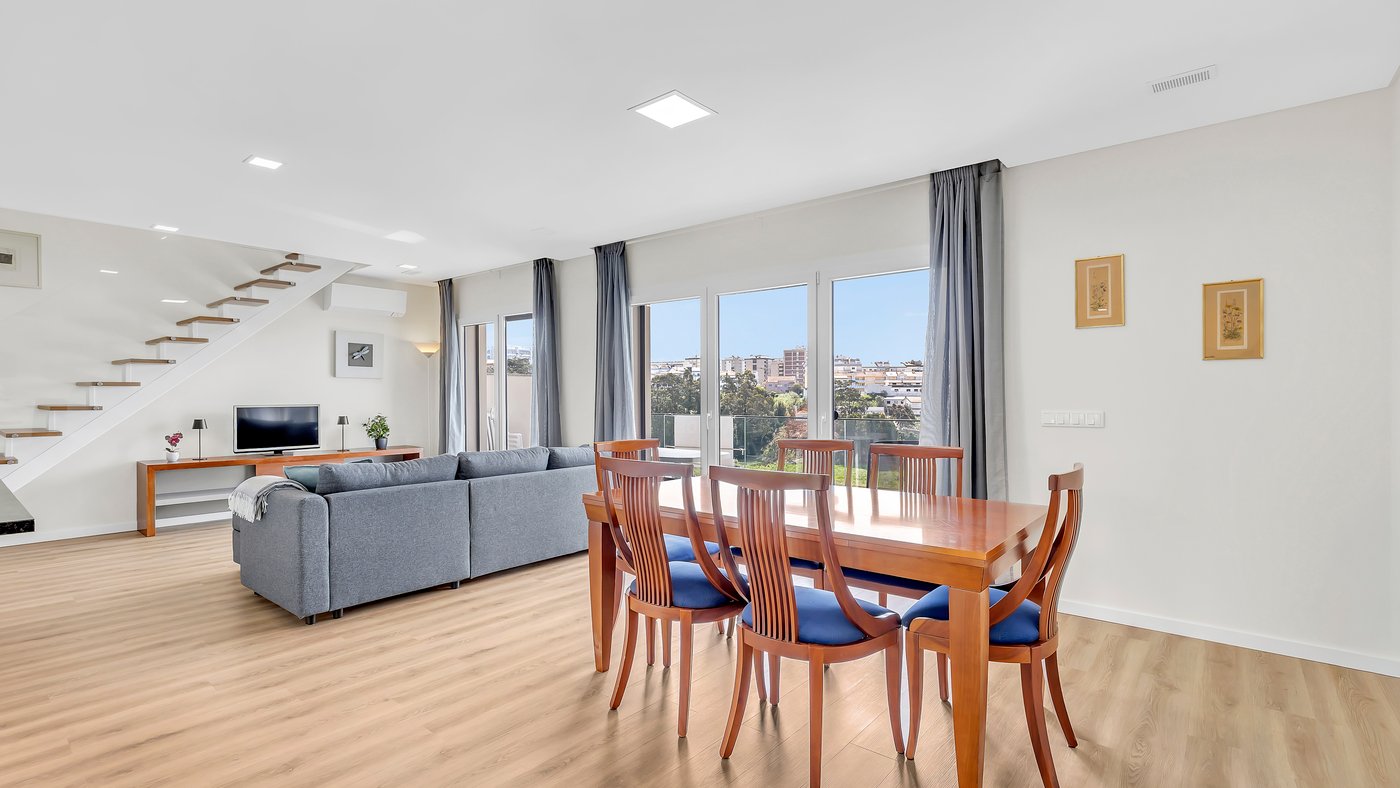
For this issue, our Editor’s Pick is the five-bedroom coastal duplex in Buarcos, Figueira da Foz. It connects directly to the first Travel Edit of September because it shows how Central Portugal can offer a different version of Atlantic living: more space, more privacy, fewer assumptions, and a coastline that still feels open.
The home includes five bedrooms, five bathrooms, 163 m² of living area, three private terraces, two built-in grill areas, garage parking for two cars, storage, and an independent studio suite with its own entrance and kitchenette. Atrium’s current listing presents the property at €695,000 and describes it as set just five minutes from one of Portugal’s distinctive Atlantic coastlines.
It is best suited to buyers who want a real coastal home in Central Portugal, with enough space for longer stays, family visits, flexible use, or a more grounded version of seaside living.
17th-Century Palace · Condeixa-a-Nova, Coimbra
The 17th-century palace near Coimbra represents another side of Portugal entirely. It is a heritage property with scale, history, gardens, outbuildings, stables and hospitality potential, set in Condeixa-a-Nova near Coimbra.
Atrium’s current listing describes it as a magnificent 17th-century palace on a 76,400 m² estate, with 23 bedrooms, 20 bathrooms, and 20,600 m² of built area. It works well in this Final Edit because it connects several Atrium themes at once: heritage, Central Portugal, estate living, hospitality potential, and the importance of understanding what a property can become with the right strategy.
It is best suited to buyers interested in historic estates, hospitality, cultural use, private legacy properties, or a larger real estate vision in Central Portugal.
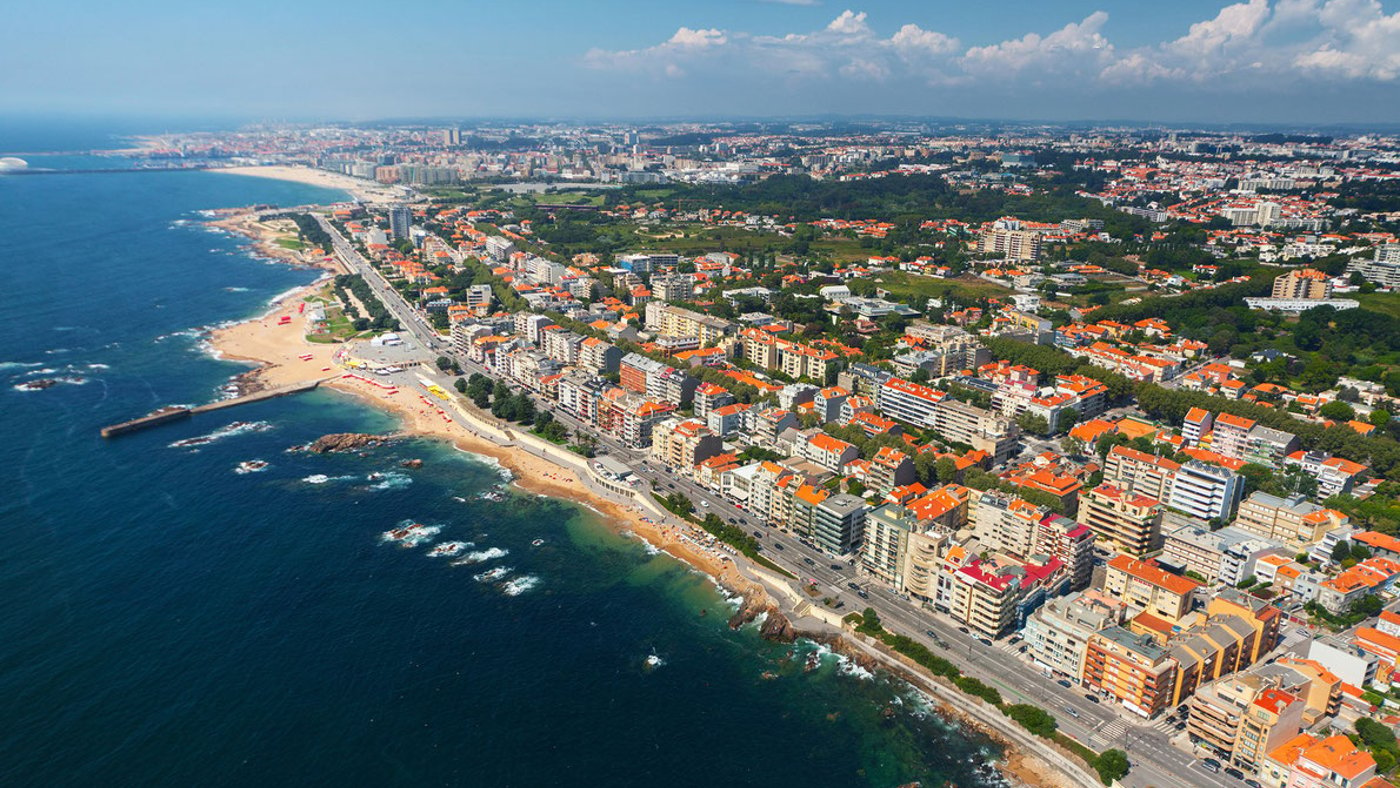
The Sway · Vila Nova de Gaia
The Sway brings the conversation back to the Porto region and contemporary coastal living. Set directly on the seafront of Vila Nova de Gaia, the development combines beachfront access, modern architecture, ocean views and proximity to Porto.
Atrium’s development page describes The Sway as an exclusive first-line oceanfront project with 82 residences across four entrances, offering one- to four-bedroom apartments and amenities including a heated outdoor pool, gym, co-working spaces, meeting rooms, social lounge, games room and landscaped communal areas.
This property belongs in the Final Edit because it offers a different answer to the same question September kept asking: what kind of life is the property making possible? For The Sway, the answer is contemporary beach living with Porto close enough to remain part of daily life.
The Market Is Still Moving, But the Story Is Regional
Portugal’s property market remains active, but the more useful story is not simply that prices are rising or that demand remains strong. The real story is regional.
Buyers are still looking closely at Lisbon, Cascais, Porto and the Algarve, but interest is also widening into places like Setúbal, Central Portugal, Figueira da Foz, Braga, the Alentejo, and other areas where lifestyle, access and relative value come together differently. Idealista’s August 2026 index reported that asking prices in Portugal rose 7.5% year over year, with the national median asking price at €3,207 per square meter, while regional prices varied significantly across the Algarve, Lisbon, Porto, Setúbal and other districts.
For clients, this means the search should be more strategic. The question is not only what can you buy, but where does the property still make sense in five years? Does the location support full-time living, rental demand, family use, future resale, or a more flexible lifestyle? Is the area already saturated, still emerging, or quietly established?
This is why Atrium looks at listings through the lens of fit. Price matters. Location matters. But so does the life around the property.
Three Conversations Worth Having Before You Choose
The last three issues were not really separate topics. They were pieces of the same conversation.
Figueira da Foz showed how a coastal place can move from a travel idea to a real lifestyle consideration. The Visa Edit showed why residency planning should be structured around the life someone actually wants to build. Portugal on Horseback showed that property decisions become more serious when animals, land, care, and long-term responsibility are part of the equation. Karen Talks brought the market conversation back to discipline: price is not just what someone asks, but what qualified buyers are willing to support. And Vince’s first article reminded us that, underneath every listing, region guide and market note, this is still a business about people and the places they call home.
That is the September note from Atrium.
Portugal is beautiful, but beauty alone is not enough. The right move needs structure. The right region needs to fit daily life. The right property needs to support more than the version of Portugal someone imagined before arriving. The right strategy should connect the pieces before they become separate problems.
This Issue, Answered
What is The Atrium Edit?
The Atrium Edit is a monthly editorial series from Atrium Real Estate and Atrium Global Visa covering Portugal real estate, regions, lifestyle, residency and relocation. This fourth issue, The September Brief, recaps the first three September issues, previews October in Portugal, includes Karen Talks, introduces a new contributor, and highlights selected real estate opportunities.
What did Issue 01, Figueira da Foz, cover?
Issue 01 explored Figueira da Foz as more than a summer coastal destination — Buarcos, the Atlantic coastline, Central Portugal, and the practical difference between visiting a seaside town and imagining a longer life there.
What did Issue 02, Residency Beyond Portugal, cover?
Issue 02 looked at residency planning beyond a single-country mindset, comparing how Portugal, Greece, Italy, Cyprus and Panama may differ by investment structure, family needs, physical presence, tax planning and long-term goals.
What did Issue 03, Portugal on Horseback, cover?
Issue 03 explored Portugal’s equestrian culture, including the Lusitano, Golegã, the Alentejo, Ribatejo, Algarve, Northern Portugal, and the horse-welfare questions that should shape any serious equestrian property search.
What is Karen Talks, and what is this issue’s essay about?
Karen Talks is Karen Kemp Aguiar Abud’s column as Atrium’s Founder and CEO, focused on real estate, wealth, mobility, market strategy and the decisions clients face when building a life across more than one place. This issue’s essay, “The Market Sets the Price. The Process Determines Whether You Get It.,” looks at Portugal’s fragmented sales data and why disciplined pricing and process — not just listing exposure — determine whether a property actually sells.
Who is Vince Cunha Vaz, and what is his first article about?
Vince Cunha Vaz is a new voice at Atrium, raised in Cascais. His first article, “Cascais: A Place to Call Home,” is a personal reflection on growing up by the Atlantic, the meaning of community, and the place he will always call home.
What is happening in Portugal in October 2026?
October brings an active cultural calendar, including Festa do Cinema Francês, Doclisboa, ModaLisboa Priority, MAAT exhibitions and Serralves em Luz. It is also a strong month for seasonal food, with chestnuts, pumpkins, persimmons, pomegranates, mushrooms, cabbages, apples, pears, grapes and autumn market produce becoming more visible.
Why include seasonal food in a real estate and lifestyle article?
Because food is part of daily life. What appears in markets and grocery stores helps people understand how Portugal actually feels month to month. October’s produce, chestnuts, wine-harvest conversations, soups, stews and autumn cooking all help show the rhythm of life here beyond property listings.
Rua do Almada 577, Cedofeita, Porto
Start with one conversation
Whether it is a region, a visa question, or a property, we can help connect it to the rest of the plan.
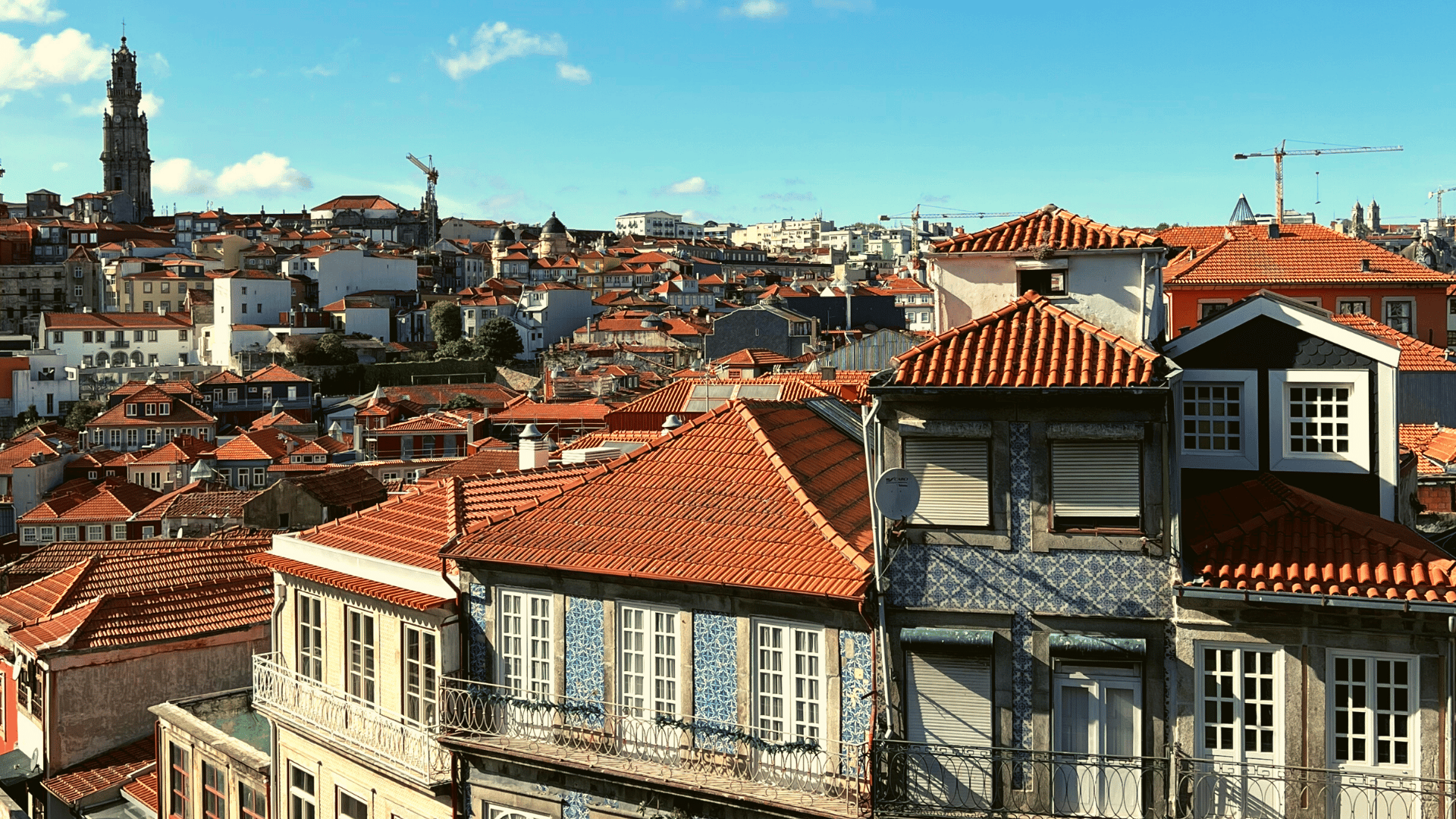
Portugal is a sequence of decisions. Let’s make them together.
Whether you are still choosing a region, mid-visa process, pricing a property to sell, or ready to look at listings, the best next step is one conversation, not three separate ones.